

Walmart's Canadian market position runs on documented competitive pricing — the Everyday Low Prices model — built on the back of three structural factors: scale-driven supplier-pricing leverage, sustained low per-employee labour cost, and a documented record of competitor-undercutting that has driven smaller regional grocers out of multiple markets.
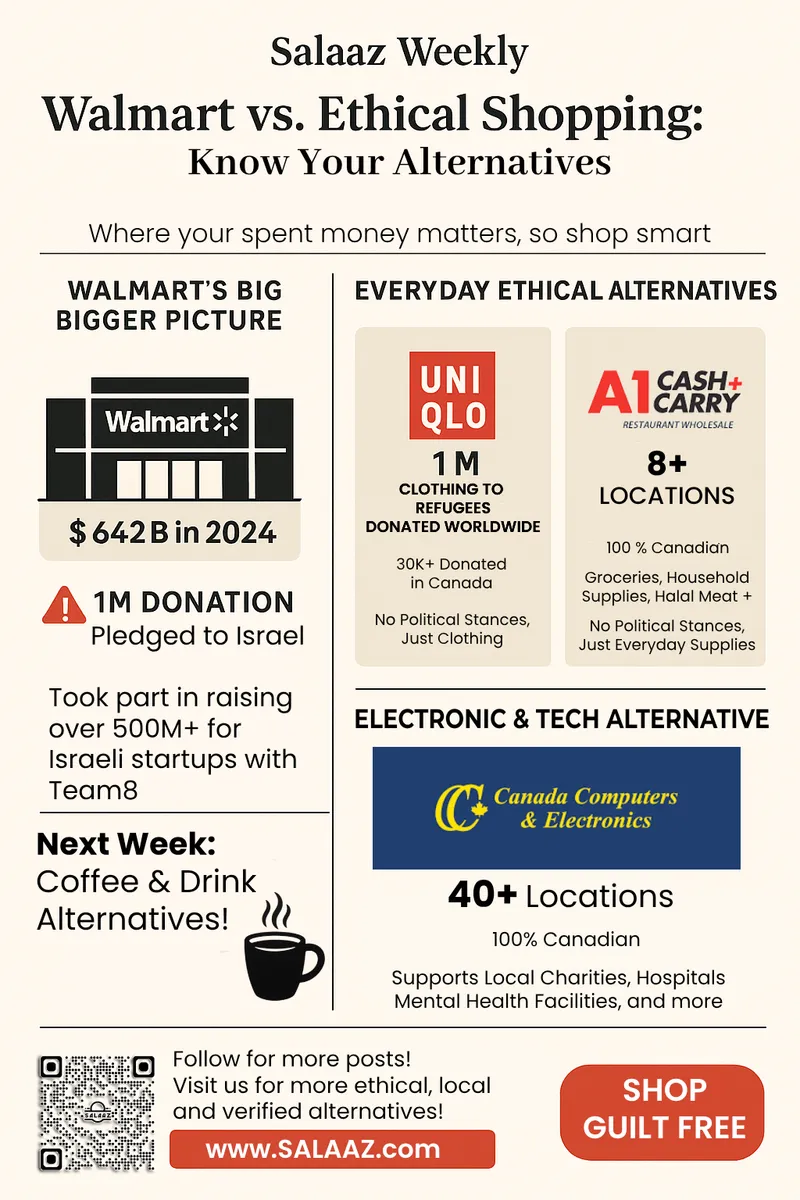
What the Walmart record contains
Three documented patterns worth knowing about:
- Supplier pricing leverage. Walmart's scale lets it impose pricing terms on suppliers that smaller chains can't match. Suppliers that decline are typically removed from product placement; the supplier-side compliance with the pricing terms often shifts cost to the supplier's own labour and farming chains.
- Per-employee labour cost. Walmart Canada employee compensation has been the subject of multiple unionisation drives across the past decade, with documented patterns of anti-union response including store closures (the Jonquière, Quebec store closing in 2005 days after union certification is the canonical case in Canadian labour law).
- Sourcing — supply-chain audit gaps. Walmart's supplier code requires periodic audit but the documented compliance record across the apparel and consumer-electronics categories has surfaced multiple cases of forced-labour and child-labour sourcing routed through tiered suppliers — covered in the broader Xinjiang cotton and cobalt supply chain pieces.
Canadian alternatives at comparable price points
The "Walmart vs ethical shopping" framing isn't a price-versus-values trade-off in the way the conventional wisdom positions it. Comparable per-item prices exist at:
- Independent grocers with shorter supply chains and direct producer relationships.
- Farmer's markets and Community Supported Agriculture (CSA) box programmes — often equivalent or cheaper per-unit on fresh produce.
- Ethnic grocery operations such as Oceans Fresh and Iqbal Foods (covered in our grocery-store piece) — competitive pricing on staples plus deeper inventory on specific category ranges.
- Cooperative grocery networks in major Canadian cities — Mountain Equipment Coop (closed in 2020) was the consumer-cooperative model; smaller operators continue the pattern.
What follows
For adjacent reading, see our grocery-store ownership concentration piece, our Made in Canada labelling guide, and our piece on Amazon's parallel marketplace pattern.