
Amazon ranks #2 in Fortune's global-company list. The corporate record at that scale runs in five documented directions; each is sourced to mainstream journalism or to court filings rather than activist claim.
Five patterns on the record
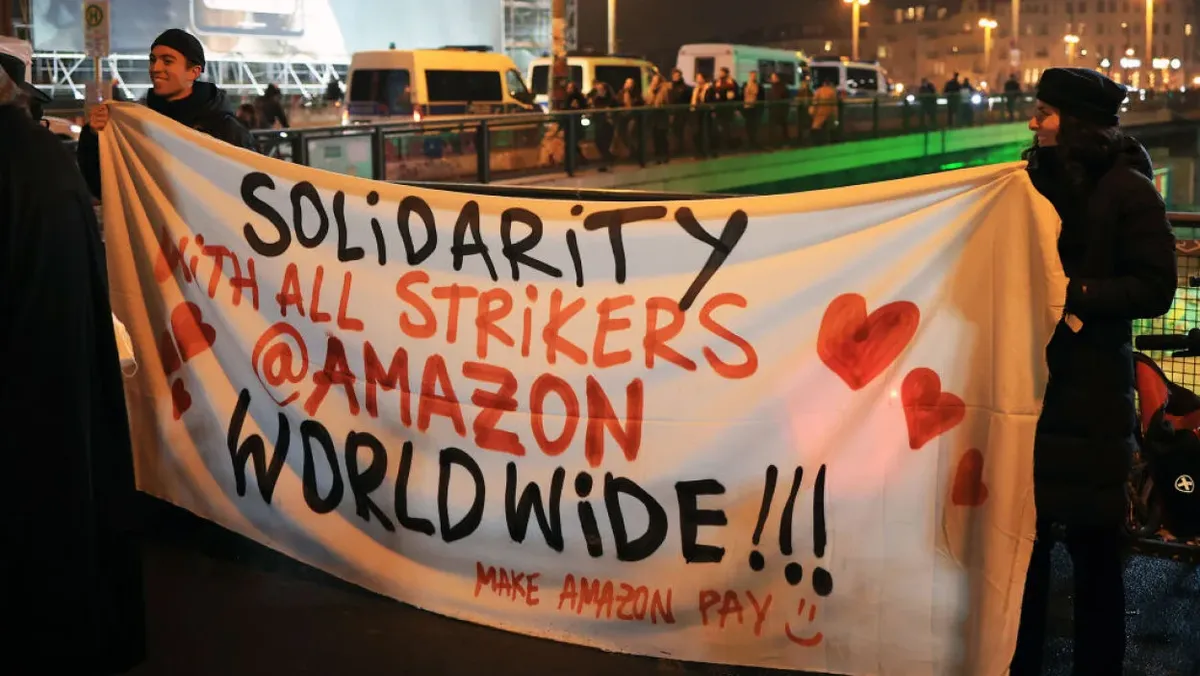
- Warehouse and delivery-driver conditions. CBC News reported on the December 2024 walkout at seven Amazon US facilities during the company's peak holiday-shipping window; the workers' core demand was health-related working conditions. The Intercept separately documented delivery drivers urinating in bottles to maintain quota under route-time constraints — a documented operational reality the company initially denied on social media before partial acknowledgement.
- Tax avoidance through legal structuring. ITEP documented Amazon's 2018 US federal income tax payment of $0 on approximately $11 billion in profit, with similarly low effective rates across multiple subsequent years through R&D credits, capital-expenditure depreciation, and stock-based compensation deductions.
- Marketplace algorithmic behaviour against third-party sellers. Digital Trends documented Amazon's pattern of identifying high-performing third-party SKUs and routing the algorithm to favour its own private-label competitor product, often within months of a third-party success signal.
- Project Nimbus and Israeli data-centre investment. Beyond the $1.2B Google-and-Amazon Project Nimbus contract reported by Al Jazeera, Amazon separately committed $7.2B to Israeli data-centre infrastructure investment.
- Privacy-breach settlements. Entrepreneur documented Amazon's 2023 $25 million FTC settlement on Alexa voice-recording practices, confirming earlier reporting that Amazon employees had access to consumer voice-assistant recordings as part of "service improvement" workflows.
Marketplace alternatives
The structural problem — convenience consolidation across a single retail interface — is real. Two partial alternatives:
eBay
- Al Mayadeen English reported in 2024 eBay's announced withdrawal from Israeli market operations with associated layoffs through 2026.
- Auction-and-fixed-price format with seller-set pricing.
- Stronger surface area for vintage, hard-to-find, and out-of-production items than Amazon's first-party-dominant marketplace.
- Buyer-protection policies have improved substantially over the past decade.
eBay's category profile is uneven — the consumer-protection rules apply to the platform, not to individual sellers' product specifications. Items sold on eBay still need the ethical-evaluation work the buyer would do anywhere.
Salaaz Marketplace — the platform you're reading this on.

- Vendor vetting against published ethical criteria (per the Ethics Engine Policy).
- No paid-placement ranking; search ranking cannot be bought.
- Supply-chain disclosure requirements at the vendor level.
What follows
A single online-marketplace dependency consolidates retail behaviour across categories the buyer would otherwise approach differently. The pattern isn't unique to Amazon — it's the structural endpoint of any sufficiently dominant marketplace. The consumer-side answer is partial: diversifying purchases across smaller, category-specific operators carries higher friction but routes a different fraction of consumer spending into a different corporate-record landscape.
For adjacent reading, see our piece on Google's surveillance and revenue model, our look at the AI labour-and-weapons economy, and our piece on planned obsolescence and the throw-away purchase cycle.