

Incognito mode is a privacy feature that doesn't do what most users assume it does. It prevents the device from logging browsing history. It does not prevent Google itself from collecting search, location, and behavioural data on the user. A 2024 class-action settlement forced Google to delete billions of records collected through incognito sessions — confirming the gap between the feature's name and its actual scope.
The full collection footprint
Per Google's own published privacy policy, the data collected during normal account use covers:
- Search queries (including those typed in incognito sessions).
- Browsing through Chrome and links accessed via Google Search.
- Click behaviour on search results and ads.
- Dwell time per page.
- Real-time and historical GPS data (Google Maps + Android device).
- IP-derived location data.
- Nearby Wi-Fi networks and Bluetooth-discoverable devices.
- Location history and travel routes.
- YouTube viewing behaviour, channel subscriptions, comments.
- Ad-personalisation interest profile built across all the above.

Four documented patterns
- The incognito class-action. CNN documented the 2024 settlement and the records-deletion requirement — the legal acknowledgement that incognito-mode collection had been beyond the user's reasonable expectation.
- Internal-dissent firings. The Guardian reported in 2019 on four Google employees fired after raising internal concerns about ethical violations, including specific objections to military contracts — protected speech under the company's own published code of conduct, per the workers' filed charges.
- Project Nimbus. Google's $1.2B AI-and-cloud contract with the Israeli government, reported by Al Jazeera in 2024; contract terms reportedly prohibit Google from withdrawing services to specific government entities for ethical reasons.
- Geofence warrants. Wired documented Google's location-data preservation enabling geofence warrants — law-enforcement requests for all device IDs present in a given area at a given time, served on Google's location store.
Alternatives that actually decouple data and product
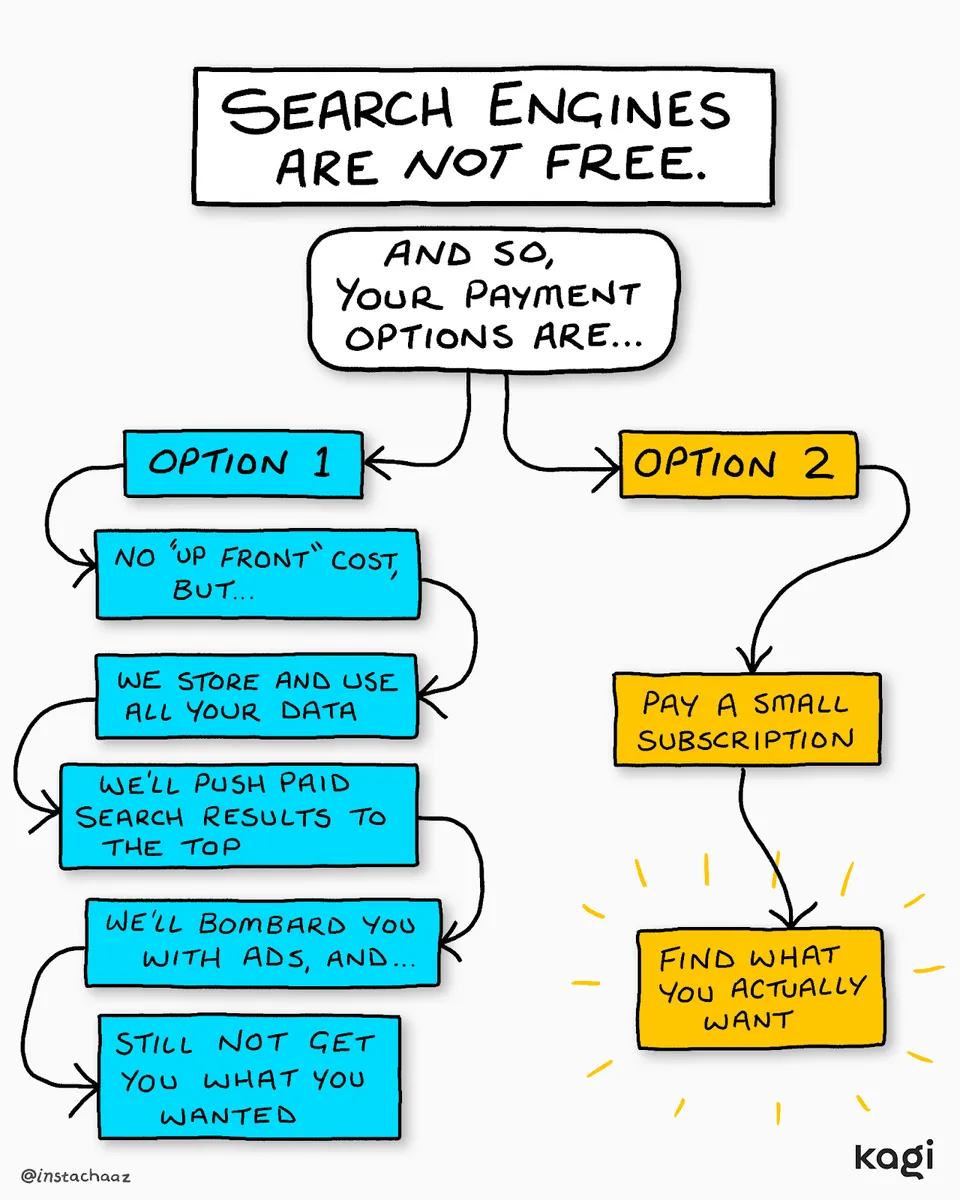
Kagi

- Structured as a US Public Benefit Corporation — corporate purpose includes commitments beyond shareholder profit maximisation.
- Paid-subscription model decouples revenue from user behavioural data; no ad-personalisation infrastructure.
- Limited free tier available; full features at modest monthly subscription.
PeerTube — YouTube alternative

- Developed by Framasoft, a French non-profit; public-funded.
- No advertising-based ranking or tracking infrastructure.
- Over 600,000 videos across federated instances.
- Decentralised architecture — no single corporate gatekeeper.
Salaaz hasn't audited either operator's full operations; the published structural model is the source.
What follows
The structural condition that produced the surveillance footprint isn't a fixable bug in Google's product — it's the business model. Advertising-funded products generate revenue by accumulating behavioural data on the audience. The alternatives that decouple revenue from data (paid subscriptions, public funding, non-profit operation) make different trade-offs but produce a different relationship with the user.
For adjacent reading, see our piece on the AI labour and water economy, our look at Amazon's corporate-power surface, and our piece on the attention-economy mental-health pattern.