

The 2025 announcement of US-imposed tariffs on Canadian imports triggered the largest disruption to North American trade since the 1988 Canada–US Free Trade Agreement negotiation. The documented economic-impact figures are substantial, and the political response — federal, provincial, and consumer-level — moved quickly.
The trade volume
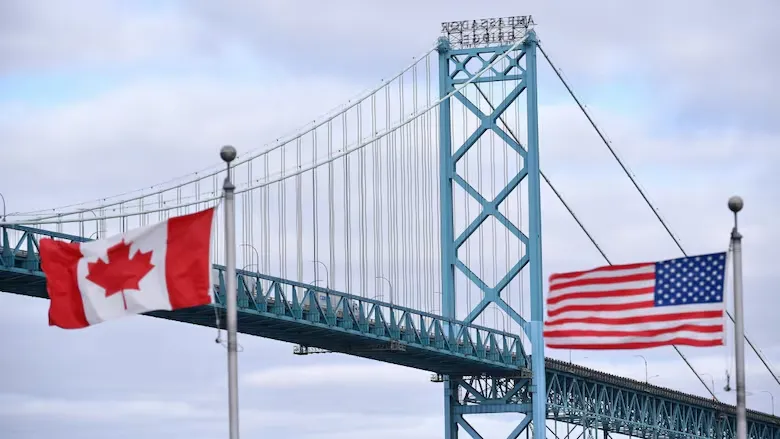
Per Statistics Canada's November 2024 trade data:
- Canadian exports to the US rose 6.8% month-over-month.
- US imports to Canada rose 4.1% month-over-month.
- The Canada–US trade surplus expanded from $6.6B (October) to $8.2B (November).
The aggregate picture per the Canadian Chamber of Commerce trade tracker:
- $3.6B in goods and services cross the border daily between the two countries.
- $1.3T annual bilateral trade — the largest two-country trade relationship globally.
- 1.4M US jobs and 2.3M Canadian jobs tied directly to the trade flow.
- Canada is the #1 export market for 34 US states.
The proposed tariff impact
The 25% blanket tariff originally proposed by the Trump administration carried documented impact projections:
- Canadian GDP would contract approximately 2.6% — equivalent to approximately $1,900 per Canadian family annually.
- US GDP would contract approximately 1.6% — equivalent to approximately $1,300 per US family annually.
The projection covers direct trade-flow contraction and indirect supply-chain disruption. Sectoral impacts vary widely: automotive, steel, lumber, and aluminum are most exposed on the Canadian side; agricultural and manufactured-goods imports are most exposed on the US side.
What changed when the tariffs were announced
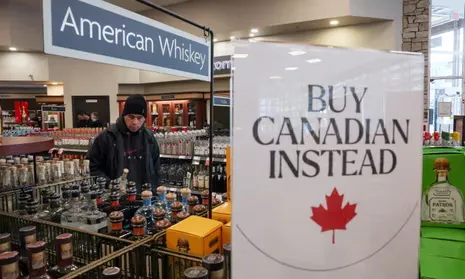
The initial announcement produced documented market and political response:
- Financial markets. Wall Street Journal documented stock-futures declines, oil-price spikes, and currency-market volatility in the trading session following the announcement.
- Ontario provincial response. Premier Doug Ford announced a ban on US-firm provincial contracts, specifically including cancellation of an existing $68M Starlink contract.
- Provincial alcohol pulls. Seven Canadian provinces moved to remove US-origin alcohol from LCBO/SAQ/BC Liquor equivalents at the consumer-shelf level.
- Independent retailer response. Buy Canadian Instead signage appeared in independent grocers and specialty stores within days of the announcement.
- Major chain response. Loblaw announced a doubling-down on Canadian-manufactured products with stated intent to substitute Mexican alternatives for US-sourced product lines where Canadian options weren't available.
What the 30-day deferral meant
Trump and Trudeau reached a 30-day deferral agreement covering border-security commitments following the initial announcement. The tariffs subsequently became operational at varying levels across product categories — the trade-disruption environment continues to shift as bilateral negotiations advance.
The consumer-side response

The Buy Canadian movement matured rapidly through 2025. Global News and others published Canadian-alternatives-to-US-brand resource lists covering grocery, household, apparel, and tech categories. The pattern reinforces structurally the Made in Canada labelling decoding work.
For adjacent reading, see our Made in Canada labels guide, our Walmart-vs-Canadian-grocer analysis, and our look at the broader grocery-ownership concentration in Canada.