
The April 28th 2025 federal election produced specific platform commitments from each of the major parties. The summary below covers the headline positions per published platform documents and the major-press platform comparisons; the citation list at the close routes to the underlying party documents.
The three major-party platforms
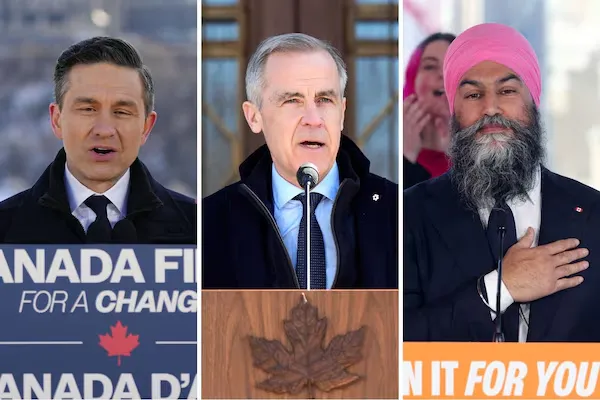
Liberal Party — Mark Carney
- Economy: $130B in new spending over four years targeting US-tariff response and economic resilience.
- Housing: GST elimination for first-time homebuyers on properties under $1M.
- Defence: $30.9B over four years; Arctic-defence priority; NATO 2%-of-GDP commitment by 2030.
Conservative Party — Pierre Poilievre
- Tax: 15% cut on the lowest income bracket; capital-gains relief for reinvestment.
- Energy: Accelerated energy-project approval; proposed national energy corridor.
- Housing: Federal sales-tax elimination on new homes under $1.3M.
New Democratic Party (NDP) — Jagmeet Singh
- Healthcare: Public pharmacare programme within four years; initial coverage of 100 most-prescribed medications.
- Housing: 100,000+ rent-controlled units on federal land over the next decade.
- Education: Student-loan forgiveness; support for Canadian-manufactured EVs.
Middle East policy positioning
A specific axis of differentiation:
- Liberals — diplomacy-and-multilateralism emphasis; supportive of ceasefire and two-state-solution framings.
- Conservatives — strong-allies framing; explicit support of Israel position.
- NDP — human-rights-and-humanitarian-aid emphasis; explicit Palestinian-rights and arms-embargo positioning.
Platform documents referenced: The Times, Reuters, CTV News, Politico.
Vote-strategy considerations

Canada uses first-past-the-post at the riding level. The strategic-voting dynamics this produces:
- In safe-seat ridings, a vote for the values-aligned party regardless of national polling sends a clearer policy signal.
- In swing ridings, the strategic calculation between values-alignment and outcome-shaping is more substantive.
- Spoiled, blank, or non-vote outcomes are documented as substantially less informative to political parties than a vote routed to any candidate including minor parties.
Smaller-party platforms worth knowing about:
- Green Party — environmental-sustainability and climate-action lead.
- Bloc Québécois — Quebec sovereignty and provincial-interest representation.
- People's Party of Canada (PPC) — individual-rights and limited-government emphasis.
- Canadian Future Party — centrist pragmatism, national-unity framing.
Practical engagement tools
- Elections Canada — voter registration, riding lookup, polling station info.
- VoteMate — side-by-side platform comparison tool with personal-issue weighting.
- VotePalestine.ca — riding-level MP letter routing for Palestine-related policy positions specifically.
- Riding-specific candidate forums — local debate coverage typically available through CBC and CTV regional outlets.
What follows
The 2025 election produced a Liberal-led government with Mark Carney as Prime Minister. The platform commitments above run on a four-year horizon; the accountability mechanism is the same regardless of which party formed government — sustained constituency-level pressure on individual MPs.
For adjacent reading, see our Eid framing of the political-engagement moment, our look at the boycott-restriction patterns elsewhere in North America, and our piece on Canadian wealth inequality and policy levers.