
The price of an iced macchiato sits on a supply chain with several failures upstream. Of the retail price, farmers receive on the order of 1%. The remaining 99% routes through processors, exporters, importers, roasters, and retailers — each of whom captures a margin while the floor of the chain operates close to subsistence.
Four structural features of the current model
-
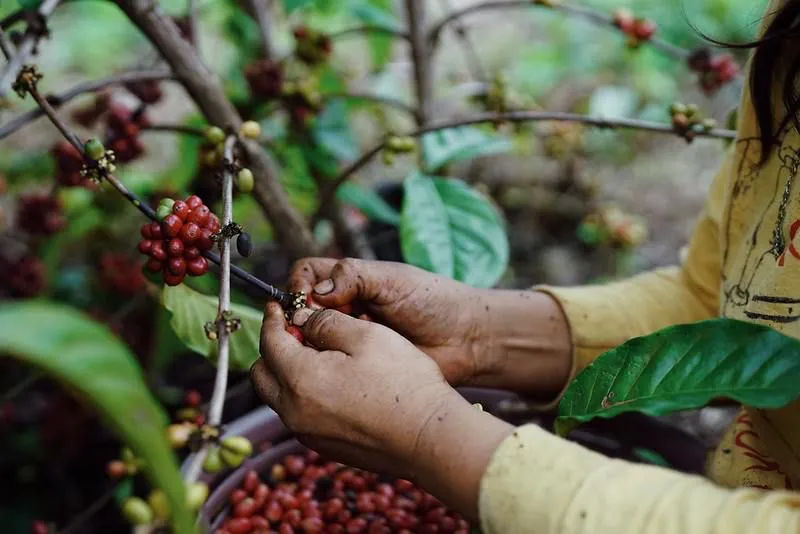
Farmer wages near subsistence. Guatemalan coffee pickers harvest hundreds of pounds per day for roughly $3 in compensation, per an Institute of Current World Affairs field report. Equivalent wage ranges appear across the producing belt — Ethiopia, Indonesia, Honduras, Peru — and have not meaningfully tracked retail price growth over the past decade.
-
Pesticide intensification. Output pressure has driven heavier and less-regulated pesticide use in producing regions. Brazil approved 475 new pesticides between 2019 and 2023; over a third are banned in the EU on toxicity grounds, per a University of Copenhagen analysis.
-
Deforestation. The New York Times reported in 2021 that coffee expansion in Indonesia consumes roughly one square inch of rainforest per cup of coffee consumed globally — a back-of-envelope per-unit figure that adds to a hectare-scale annual loss.
-
Soil-base collapse. A 2021 Regional Environmental Change paper projects the land area suitable for coffee cultivation will contract by approximately 50% by 2050 under current trajectories, combining climate shift with soil degradation from continuous monoculture.
The first three are labour-and-extraction problems. The fourth is the medium-term financial floor: the supply chain is consuming the resource it's selling.
Direct trade as a structural alternative
Direct trade compresses the supply chain — the roaster contracts directly with the producer, with audited price and volume terms. Disclosed pricing is the leverage; it lets a buyer see what reached the farm.
Roasters publishing against the direct-trade pattern with disclosed pricing include:
- Phil & Sebastian (Calgary)
- Counter Culture Coffee (Durham, NC)
- Onyx Coffee Lab (Arkansas)
- 49th Parallel (Vancouver)
Salaaz hasn't independently audited each operator's farm-level books; their published transparency reports are the source. Direct-trade pricing is generally several multiples of commodity coffee — the gap is roughly where the farmer wage sits.
The cup itself

The disposable cup is the other half of the unit economics. Single-use plastic-lined paper cups are functionally non-recyclable in most municipal streams. Compostable alternatives — particularly bamboo-based disposables — work on a different time horizon:

- Bamboo grows roughly 30 times faster than the hardwoods used in conventional disposable manufacturing, per a 2023 Science China Earth Sciences review.
- The plant regenerates from rhizome without replanting, and standard cultivation requires limited pesticide input.
- Reusable glass for in-store service remains the lower-impact option where the operating environment supports it.
What follows
A coffee habit isn't the problem. The price discoverable at the farm gate is. Where the retail end disclosure improves and the supply chain shortens, the structural picture improves with it. For adjacent reading on the broader pattern of commodity-supply opacity, see our pieces on rice supply chains, spice routes and labour inequality, and the prison-and-processed-food labour pipeline.