
The fishing industry sits at the intersection of two crises: a labour-rights problem at the workforce level, and an ecological problem at the species level. Both are documented, both are still escalating, and both run on the same supply chain that delivers fish to the supermarket counter.
The labour problem
The International Labour Organization's 2023 report on forced labour in fisheries estimates approximately 128,000 workers trapped on remote fishing vessels globally, typically migrant workers from low-regulation labour markets. Confinement at sea structurally prevents the standard labour-rights interventions — workers can't walk off, can't access regulators, can't communicate with families.
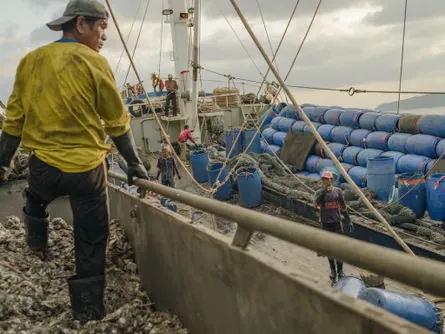
The FAO has separately documented the chronic-illness, malnutrition, and mortality profile of the trapped-fisher workforce; the pattern is comparable to the indenture conditions in the worst-case land-based migrant-labour cases.
The ecological problem
The species-level numbers are simultaneously deteriorating:
- The Pew Charitable Trusts documents approximately $22 billion in annual government subsidies that explicitly drive overfishing — fuel, gear, and vessel-construction subsidies that make uneconomic fishing economically viable for the fleet operators.
- The Inter-American Institute for Cooperation on Agriculture estimates approximately one in five fish caught globally is illegal, unreported, or unregulated — the share that operates entirely outside the regulatory frameworks meant to manage species populations.
- The World Wildlife Fund estimates over one-third of global fisheries are overexploited at current effort, particularly affecting top predators (sharks, rays, tuna).
- National Geographic's reporting on marine debris attributes more than half the Great Pacific Garbage Patch — a debris field measured larger than Texas — to abandoned fishing nets.
- A 2021 Guardian investigation tested ~9,000 seafood products globally and found Canada's market carried the highest documented seafood-mislabeling rate at 55%.
A 2006 Science paper, frequently re-cited as the population trajectory has continued downward, projected commercial fishery collapse by 2050 on the then-current trajectory. Subsequent updates haven't materially shifted that projection.
Two certifications that audit something
Marine Stewardship Council (MSC) Certification — wild-caught fish.
- Stock-health audit on the certified fishery.
- Environmental-impact audit covering bycatch and habitat.
- Chain-of-custody traceability from boat to retail.
Aquaculture Stewardship Council (ASC) Certification — farmed fish.
- Environmental-impact audit on the farming operation.
- Feed sourcing documentation (ASC-certified operations cannot use forage-fish feed from unsustainable wild catches).
- Worker-condition audit on the operating site.
- Separate stream from non-certified product through chain-of-custody.
Salaaz hasn't independently audited either certifier; the certifications are imperfect but represent the operating standard for traceable seafood in the current regulatory environment.
What follows
The fishing industry has two unsolvable problems on its current trajectory: it's depleting the resource it sells, and it's running a labour model that is by design unauditable. The substitutions are partial — eating lower in the food chain (smaller, more abundant species), substituting plant-protein in some meal categories, buying MSC/ASC where the certification is available.
For adjacent reading, see our piece on the broader sustainability-in-farming question, our look at SAWP and migrant labour in Canadian agriculture, and our piece on microplastic accumulation in marine species.